What is IOS?
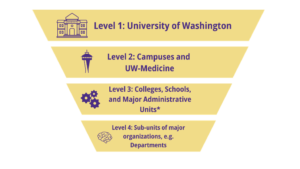
The Institutional Organization Structure (IOS) is a central hierarchy that reflects the high-level organizational structure of the major units such as campuses, colleges, schools, etc. The four-level hierarchy is designed to operationalize the “official institutional hierarchy” across data sources and systems and to enable high-level management reporting and cross-domain analysis. The new hierarchy will replace the use of Financial Organization Codes, where appropriate, in non-financial reporting. This hierarchy will be maintained within the Office of Planning & Budgeting through the Core Data Hierarchy Management Tool (CDHM) where mappings to other primary hierarchies will be made available. Quarterly snapshots of output from the CDHM tool, for use by the university community, are available in the Enterprise Data Warehouse (EDW) in the Core Data database. For more information, please contact uwir (at) edu.
Background
Although the UW has an “official” org structure outlined in APS 1.1, this structure is not codified in UW’s systems or technology platforms. The financial structure established in FAS has come to serve this purpose and is known as the “FinOrg”. Other enterprise systems (space, students, research, and advancement) have adapted their architecture to adhere to FinOrg. With the implementation of Workday Finance, the FinOrg structure is no longer maintained. Even though FinOrg was broadly used, it was not sanctioned as the UW’s institutional structure. A formally sanctioned IOS provides the “spine” to which Workday and all other enterprise systems can align and ensure interoperability in reporting and analytics across technology and data domains. The IOS, then, becomes the way in which we code administrative data to represent common elements across major data systems and provides a commonly accepted representation of the institution. This new structure is updated quarterly and maintained by the Office of Institutional Data & Analysis.
How does it compare to other hierarchies?
The IOS is intended to be system agnostic. The IOS structure will facilitate and standardize reporting that crosses domains and systems without being dependent on any one data source or system. Currently, the HR, Academic and Finance hierarchies are mapped to the IOS, with additional hierarchies scheduled. Work to ensure alignment and outreach to units for feedback is ongoing.
What is the intended use of the IOS hierarchy?
With the goal of providing a common structure that crosses systems, the IOS facilitates the following operations:
- Institutional reporting within and across domains
- Analytics used for high-level decision-making
- Workflow processing
For many report developers and data analysts, there are options based on the type of data in your report and how you would like to visually display any disaggregation. Not all reporting challenges require the use of IOS; primarily, it should be used to facilitate cross-domain reporting and non-financial uses of the former FinOrg.
Basic Structure
Officially recognized campus elements are assigned a unique identifier (node) to provide a common code across systems. There are four levels spanning from an entire university population down to sub-units of major organizations (e.g., departments). The IOS Code is a 9-character alphanumeric string that starts with “IOS” and has a 6-digit number with 0 padding.
- Level 1 (University of Washington) will always have a value of “IOS000001.”
- Level 2 (campuses and UWM) will take values “IOS000002” – “IOS000004.”
- Level 3 (major administrative units) will take values “IOS000005” – “IOS000099.”
- Level 4 (departments) will take values “IOS000100+.”
IOS Levels 1-3 will have NULL values for hierarchy levels that are lower than them. For example, the Seattle Campus would have a Level 1 IOS code (“IOS000001”) because it is at the University of Washington and a Level 2 IOS code (“IOS000002”) to represent UW-Seattle. However, it would have a NULL value for Levels 3 and 4. In contrast, the Geography department at UW-Seattle would have a Level 1 IOS code (“IOS000001”), a Level 2 IOS code (“IOS000002”), a Level 3 IOS code (“IOS000006”) to represent that it is in the College of Arts and Sciences, and a Level 4 IOS code (“IOS000475”) to represent its department.

You can combine these to create the IOS Lineage Code (1 – 2 – 6 – 475). The IOS Lineage Code highlights the interconnections between these levels. However, you will only need the code for a given level to map it across domains. Additional Mappings to academic data have been updated to replace the FinOrg mappings. These mappings allow users to join academic degrees, majors, and course activities to the IOS hierarchy as well.
Where do I find IOS?
If you would like to use IOS mappings for cross-domain reporting and analysis, you will need to join the hierarchy tables published on the EDW in the Core Data Database. Frozen snapshots of data tables are maintained in the Core Data Hierarchy Management Tool (CDHM) and are copied over to the EDW quarterly. Current Mappings Available:
- Academic Hierarchies (SDB-based and Curriculum, Majors, Degrees)
- HR Org Hierarchy (new)
- Cost Center Hierarchy (new and still evolving)
Additionally, the IOS hierarchy structure is incorporated in some campus systems, with others to follow. Note: Updates and alignment around mappings are still a work in progress. Domain-specific governance for hierarchy maintenance and governance around mapping alignment work (initial work and maintenance) is ongoing. Please anticipate changes to continue over the course of FY24, with some stabilization to follow FT stabilization. Finally, evolving structural and functional needs will drive changes. Naming revisions, new elements, organizational shifts, and new or changes to major organizations will need to be recorded within the IOS hierarchy. These changes will be made only after careful consideration of the impact on other systems and reporting. Please stay informed (check back here for updates), especially if you incorporate IOS Hierarchy data and/or business rules within local systems.
When will it be implemented?
Effective October 2023, IOS hierarchy tables are in the EDW and available to use. The next refresh of the tables and mappings will occur just after the Winter Quarter Census.
Is there a process for requesting changes?
The IOS structure must conform to a standardized business model that has been validated by each unit. Any structural changes will flow through an established approval process. For more functional changes, approval may be handled at the local level (e.g., Dean/VP or delegate).
- Consult the Administrative Organizational Change Policy webpage for guidance on the approval process for administrative units.
- To request a new IOS entity, please use this form.
- To request a change to an existing IOS Level 3 or 4, please use this form.
Who can I contact if I have questions?
To learn more, there are subject matter experts on hand to support you. IOS: uwir (at) uw.edu. Data domains: consult the Data Governance Data Domain webpage for contact information
Frequently Asked Questions
Q: Will there be any mapping available from IOS values to legacy FinOrg values?
A: No, not directly. The Workday Finance FDM translator tool may be of use.
Q: What are some limitations for use of IOS (when NOT to use IOS)?
A: IOS has 4 levels, from 1 to 4. If there is a need for hierarchical data below level 4, IOS would not be the right choice.
Q: Was UW Medicine involved in making decisions about the IOS structure?
A: UW Medicine representatives participated in several IOS working groups between 2020 and 2022; however, all related issues/concerns have not yet been resolved.
Q: Where can I find mappings across all the hierarchies, including IOS?
A: Mappings of 4 of 6 identified data domain hierarchies are under development or published in CDHM. Once current validation efforts across domain mappings is completed, the CDHM tool will house all mappings.